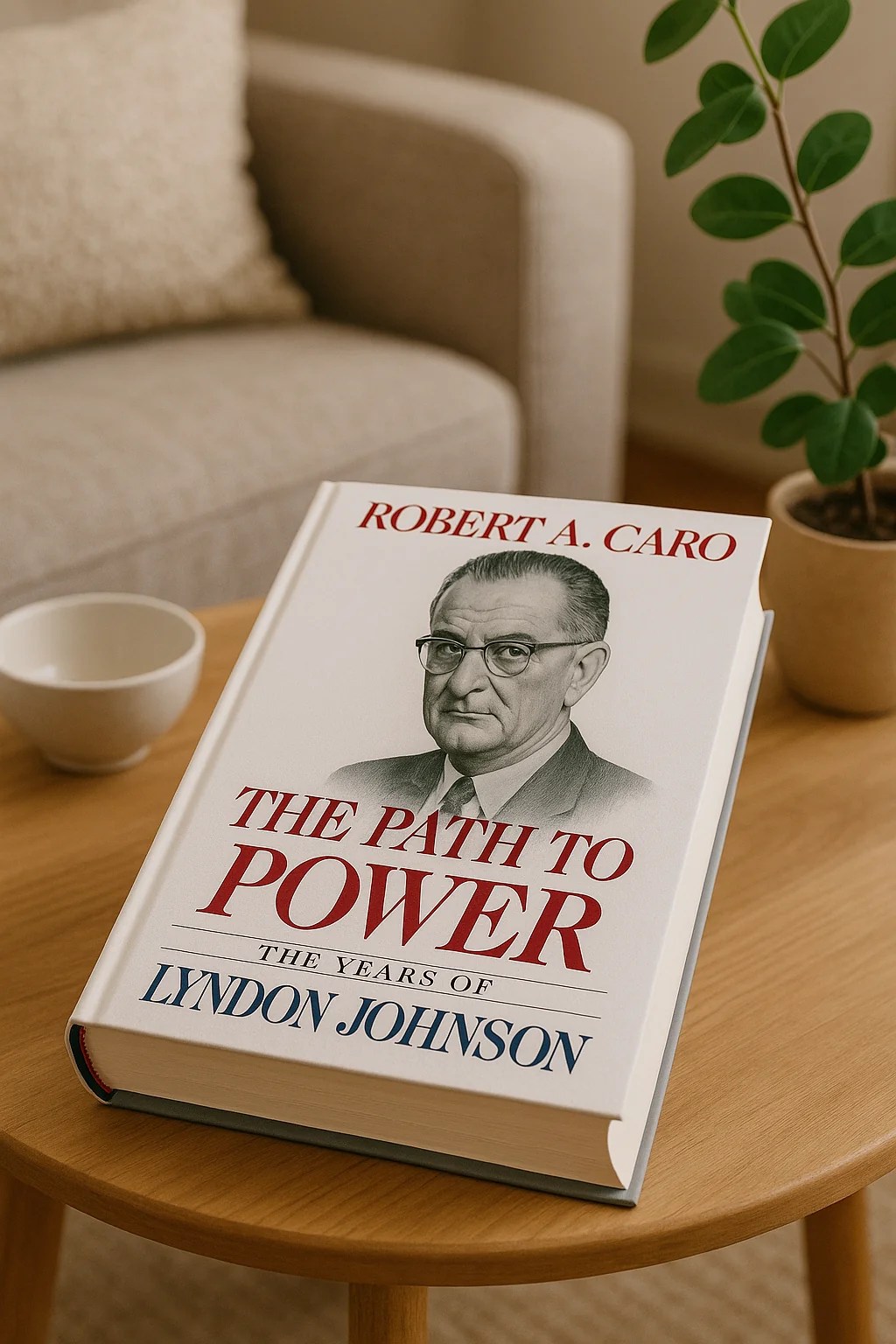
It is difficult to read the news today without sensing that something is deeply wrong in America. Trust in our institutions is eroding, and Americans feel more divided than ever. The presidency—once viewed with reverence—has become a lightning rod for controversy, skepticism, and (for me) dispare. This is partly why I chose to read The Path to Power by Robert Caro. I sought to understand another era of American turbulence, the rise of Lyndon Baines Johnson, which I consider a moment in our history that closely parallels our own. While history may not repeat itself, it often rhymes. And we would do well to learn from it.
The Path to Power is the first volume in Caro’s monumental biography of LBJ. It traces Johnson’s life through his early political career and his unsuccessful 1941 Senate campaign. This is not merely a book about one man’s ascent—it is a study of ambition, manipulation, and the machinery of American politics. Reading it in 2025, against the backdrop of a deeply divided nation, feels strikingly timely.
Before turning to the substance of the story, it is worth acknowledging the exceptional quality of Caro’s writing. He did not simply document a life; he constructed a vivid world. His account brings to life the poverty-stricken Texas Hill Country, all the individuals who shaped Johnson’s development, and the procedural intricacies of legislative politics—elements that most histories reduce to footnotes. Remarkably, despite its length of over 700 pages, the book is consistently compelling.
The depth of Caro’s research is staggering. He spent years interviewing Johnson’s classmates, combing through dusty records, and visiting the locations where Johnson lived and campaigned. Yet the brilliance of the book lies not only in its detail but in its narrative pacing. Caro writes with the finesse of a novelist, knowing precisely when to build tension and when to deliver insights that leave you staring at the page.
The portrait he offers of Johnson is both admiring and deeply troubling.
LBJ’s Ruthless Rise
One of the central themes of The Path to Power is Johnson’s relentless ambition—limitless, consuming, and often unbound by moral constraints. From his college years, where he charmed and manipulated his way into student leadership, to his early work for Congressman Kleberg, Johnson was perpetually maneuvering, always angling to acquire power.
Even in his earliest political activities, Johnson demonstrated a willingness to exploit democratic norms. While studying at San Marcos College, he orchestrated student elections by coordinating a secret network of supporters to vote in every grade-level contest. Because verifying class membership was difficult, Johnson’s strategy allowed his faction to sweep all elections in a single day. Later, during his tenure in the “Little Congress”—a mock congressional body for Capitol Hill staffers—he secured victory by mobilizing votes from janitors, elevator operators, and other auxiliary staff whose eligibility was not explicitly prohibited by the bylaws. These were not simply clever tactics; they were indicative of a broader pattern that would define his career.
Caro does not shy away from revealing Johnson’s more troubling qualities: deceit, backroom dealings, and the use of money and patronage to secure loyalty. Johnson needed power, and he was willing to compromise almost any principle to obtain it. Perhaps the most stunning example comes during his 1941 Senate campaign, where, backed by powerful business interests and equipped with perhaps the first sophisticated media operation, he came close to purchasing the election outright. The details, which I will leave for the reader to discover, are both fascinating and unsettling.
It is not that Johnson lacked convictions. He could be compassionate, even visionary particularly on issues like poverty. But Caro makes it clear that ideology was always subordinate to strategy. If adopting a position helped him win, he embraced it. If it hindered his progress, he abandoned it. For Johnson, the end always justified the means.
The Modern Echo
As I followed Johnson’s early campaigns, I found myself drawing inevitable comparisons to Donald Trump. The two men differ greatly in background. Johnson was a career politician coming from poverty steeped in institutional knowledge, while Trump emerged as an outsider—but the methods they employed to attain power bear a striking resemblance.
Both men capitalized on widespread discontent. Johnson appealed to rural Texans who felt neglected by political elites in Austin. Trump tapped into the economic and cultural frustrations of voters across Americans heartland. Both utilized media and financial resources. Johnson through radio broadcasts and political patronage and Trump through social media and relentless media attention—to shape narratives and influence public perception, often with little regard for the truth.
Perhaps most notably, both demonstrated an uncanny ability to adapt their messages to suit political expediency. Johnson did not begin as a New Deal supporter; he became one when it served his ambitions. Similarly, Trump’s populist messaging did not define his pre-politics identity, but he adopted the language and symbols of the movement to build a loyal base.
In both cases, concern for the long-term health of democratic institutions appeared secondary to the pursuit of personal power.
Why Read The Path to Power Now
Caro likely did not intend The Path to Power as a cautionary tale, yet it reads that way today. It reminds us that even celebrated political figures are shaped by compromise—not only with others, but with their own ethical boundaries. The book illustrates how those who are ambitious, well-funded, and tactically astute can exploit institutional weaknesses in a democracy.
It also forces us to reflect on what we value in our leaders. Do we prize effectiveness above integrity? Is ambition to be celebrated or scrutinized? And how do we safeguard democracy when those most eager to lead are often the most willing to bend its rules?
The Path to Power is more than a biography—it is a mirror. Through the story of Johnson, Caro illuminates the mechanisms of American politics, both then and now. The book does not provide answers, but it asks the essential questions. And at a time of national division and disillusionment, that may be exactly what we need.





 The Middle Z
Leave a comment