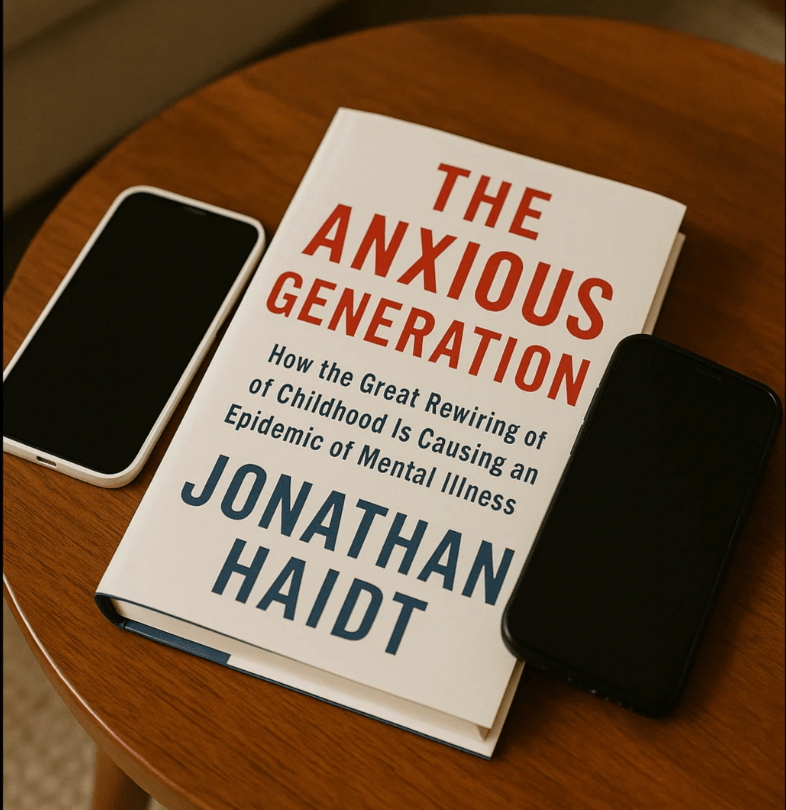
Few books have struck me with the relevance and urgency of The Anxious Generation by Jonathan Haidt. It didn’t feel like I was encountering new realizations, but rather like someone had finally put data and language to something I’ve long sensed. For those of us who grew up during the rise of smartphones, social media, and online gaming, this book resonates with me on a personal level.
I’ve often felt that something changed in how people my age were raised with screens. The constant presence of devices, the migration of our social lives onto platforms, the decline of unstructured play and in-person interaction—these didn’t feel like small shifts. But until now, they’ve been hard to articulate. Haidt’s book brings clarity to these hunches with research and a compelling historical narrative.
Thankful for the Scientific Method
I want to acknowledge how refreshing it is to see a researcher approach this issue so rigorously. It’s easy to make sweeping claims about social media like so many people do, but Haidt grounds his arguments in data, cultural comparisons, and a timeline of technological adoption. He shows that the generation raised post-2010 has undergone an enormous experiment. One that, based on current trends in mental health, is having real consequences.
The statistics he shares are stark: rising anxiety, depression, and self-harm among teens, especially girls, all tracking with the widespread adoption of smartphones and social media. For years, these trends were discussed vaguely, but this book give us tangible proof.
The Girls: Trapped in the Mirror
One of the most striking themes in the book is the impact of social media on teen girls. Speaking from my own experience, I’ve chosen to remove myself almost entirely from social platforms (Yes i see the irony of having a blog). But even as an adult, I’ve felt the psychological toll of scrolling through curated successes, especially on platforms like LinkedIn. For teenage girls, who are still figuring out who they are, Haidt hows that this effect is magnified.
Haidt outlines how social media has created a public arena where girls are not just connecting, but performing. Their value gets measured in likes and comments, and their online presence becomes a kind of currency. What’s most harmful, though, may be the unspoken cues—the absence of vulnerability, the glossy highlights, and the unrealistic beauty standards that dominate feeds.
He emphasizes that these platforms are not neutral. They are designed to be addictive, to encourage comparison, and to reward popularity. And while they promise connection, they often deliver anxiety.
The Boys: Lost in the Game
Haidt also discusses how boys have been affected differently. One of the sections I found most insightful was about the role of video games. While gaming can absolutely be social and enjoyable, it can also become a major source of distraction. For some boys, games begin to replace real-world interactions and physical activity.
This resonated with me personally. I’ve had periods where games became my default mode of downtime. When rewards and progress are built into every interaction, real life can feel slow by comparison. Haidt also notes how features like loot boxes can mimic gambling, raising concerns about addictive design choices.
To be clear, Haidt isn’t anti-gaming. He calls for balance and awareness. The point is not that games are inherently bad, but that they can edge out other important experiences if left unchecked—especially in the formative years of life.
The Bigger Picture: Screens and Social Confidence
One of the broader ideas in the book that stuck with me is how screens are affecting our basic social skills. Constant exposure to notifications and digital interactions might be eroding our ability to read faces, handle silence, or navigate boredom without stimulation. These are foundational social skills, and if they’re not developed early, they can be difficult to build later.
I find myself wondering what this means for my generation and the ones that follow. Will we see people struggle more to form deep friendships or handle romantic relationships? Will workplace dynamics change if in-person interaction becomes even more uncomfortable? My answer is yes.
The loneliness epidemic is also increasingly visible. Haidt draws a clear connection between this and the role that devices have come to play in our daily lives. In seeking convenience or connection online, we may have lost some of the depth and spontaneity that made those connections meaningful in the first place.
A Call to Awareness
If I had one critique, it’s that I wanted more emphasis on solutions. Haidt does propose ideas; delaying phone access, keeping social media out of middle school, and setting community norms. However, the scope of the problem makes it hard to know where to begin.
Still, raising awareness is a meaningful first step. I’d recommend this book to anyone who’s grown up in the digital age or is trying to understand what that experience is like. For me, reading it was like seeing my own adolescence explained with a clarity I hadn’t found before. It gave shape to a period of life that often felt confusing.
We might not be able to change how we grew up, but we can understand it better and help shape a healthier path forward for those growing up now.





 The Middle Z
Leave a comment